)

#ThrowbackThursday | One year since ISMOS-10 in Nashville, US
It’s hard to believe that it’s been almost a year since our Research Scientist, Lucy Owen, attended and presented at the 10th International Symposium on Applied Microbiology and Molecular Biology in Oil Systems.
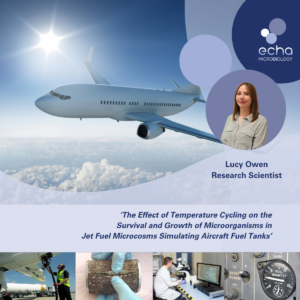
One of the highlights for ECHA was Lucy’s presentation examining the impact of temperature cycling on microbial survival and growth in aircraft fuel tanks. The research explored how microorganisms respond to the extreme freeze-thaw conditions experienced during flight, where fuel tank temperatures can fall below -40°C before returning to ambient temperatures on the ground.
A year later, the findings remain just as relevant.
Our study demonstrated that microorganisms can survive repeated freeze-thaw cycles and rapidly resume growth when temperatures increase. We also found that biofilm survival on aluminium surfaces was largely unaffected by temperature cycling. These insights continue to highlight the importance of proactive microbial monitoring in aircraft fuel systems, helping operators identify contamination risks before they develop into issues such as filter blockages, microbiologically influenced corrosion, and potential impacts on operational reliability.
ISMOS-10 also reinforced the critical role that microbiology plays across the energy sector, from understanding biodegradation and corrosion mechanisms to supporting innovation and safer, more efficient operations.
We’re proud to have contributed to these important discussions and to have shared our research with the global ISMOS community.
And with ISMOS taking place every two years, we’re already looking forward to reconnecting with colleagues, sharing new research, and continuing the conversation at ISMOS-11 next year.
What were your standout memories or takeaways from ISMOS-10?
#ThrowbackThursday #ISMOS10 #Microbiology #AviationFuel #AviationSafety #Research #Innovation #MIC #EnergyResearch #ECHA